

I built a sales workflow with 12 jobs. Only 4 needed AI.
I built a small-business sales workflow from one enquiry I never sent. The useful part was deciding what the customer needed, what the owner needed, and which jobs genuinely belonged to AI.

I wanted insect screens for my flat, found a supplier and opened the enquiry form. Then I closed it.
I expected that I would submit my details, receive a call and perhaps wait 2 weeks before I knew the price. I had no confidence that the eventual offer would be affordable, and I did not want to spend time going through the process to find out.
From a customer perspective, nothing dramatic happened. Nothing even bothered me enough to complain. I simply did not proceed, and the business never knew that I had been there.
But I have spent most of my career looking at commercial systems, and I knew where the bottleneck was. I also suspected that I was probably one of many customers disappearing in that quiet way. That second point is still a hypothesis. One abandoned form tells me where to look, and a real business would have to tell me how much the problem costs.
So I built Sofortli, a working demonstration with sample data, to see what the process would look like if the customer and the owner could both see what they needed earlier.
I mapped 12 jobs across the workflow. Eight belonged to information design, CRM, rules, automation, optimisation, analytics and qualified judgment. Only 4 genuinely required AI.
The capacity problem I know
I used to work in small businesses, and I founded companies myself. In my experience, the answer to extra work was rarely another hire. The team was considered big enough, and every person carried more tasks than the role on paper suggested.
That usually meant overtime, evenings and weekends. It also meant that procedures were missing, systems were weak and a great deal of the operation remained in the owner’s head. The owner became the system, with manual control over enquiries, offers, appointments and follow-up.
And there is an illusion between activity and result. Everybody can be fully occupied and still have no clear view of which activity is creating sales, which lead needs attention today, where customers are leaving the process or how much capacity is being spent on work that produces nothing.
This is my operating hypothesis for Sofortli. During a busy season, owner attention, appointment time, skilled labour and driving capacity are limited at the same moment that demand is strongest. Recruitment may take longer than the season allows. I want to know whether the business can get a higher commercial output from the capacity it already has.
That question gave the system 2 connected views. The customer needs enough information and confidence to continue. The owner needs a complete commercial picture and a workable action order.
What the customer needs earlier
In my case, price context was missing at the point when I had to decide whether the process was worth entering. Sofortli asks for the product route, approximate dimensions, colour and options, then uses a sample price table to return a guide range before asking for contact details.
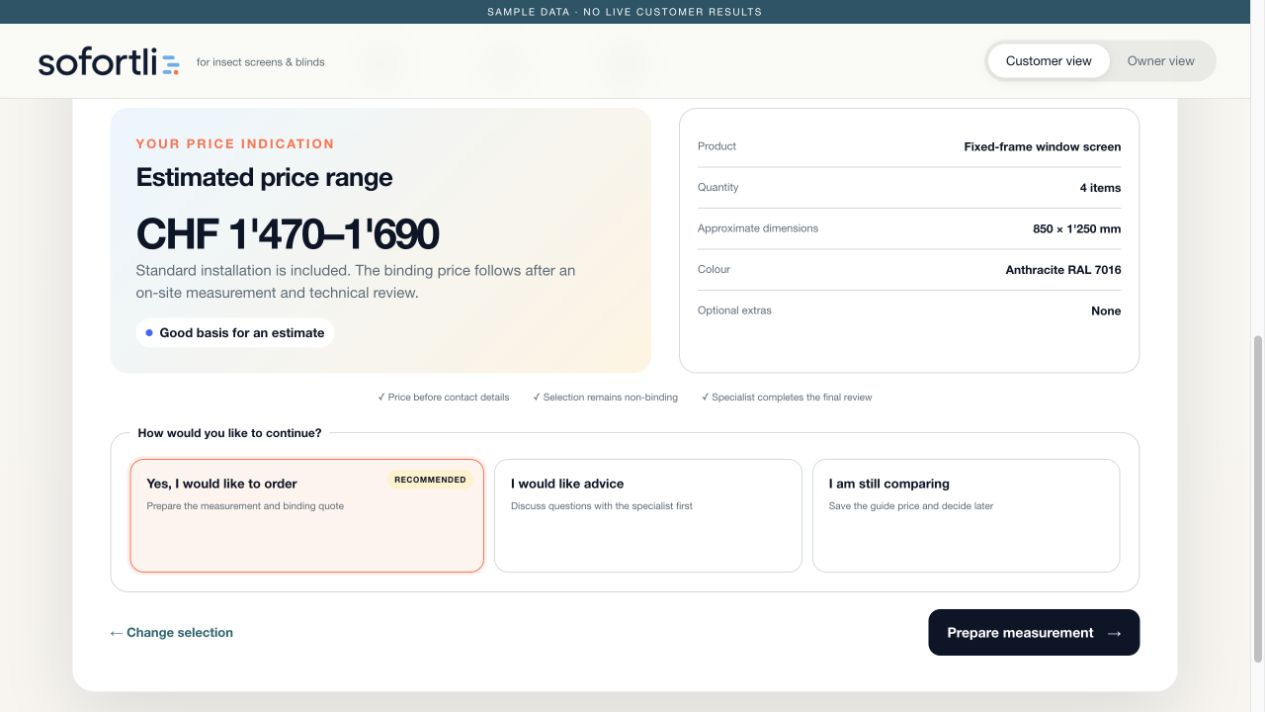
Sofortli working demonstration. Sample data and sample pricing. The binding price follows a qualified on-site measurement and technical review.
For the customer, the immediate output is enough price context to decide whether to continue. For the owner, the enquiry now carries the range shown, the customer’s stated intention and the requested next step. Approximate measurements are enough for that first range, while the qualified person still owns the final measurement and binding quote.
The guide price is only useful if the business result changes. I would compare journey completion, measurement visits, quotes, signed orders and travel per signed order. That would tell me whether placing the price earlier improves the commercial process or simply moves the same loss to another stage.
What I would want to see at 07:00
If I were the owner, my first requirement would be to capture every lead. I would want the enquiry whether it arrived during office hours or at 22:00, whether the customer spoke my language or another one, and whether they knew the product name or could only describe the problem.
Then I would want all of that information in one place. The product, approximate measurements, photographs, guide range, customer intention, requested appointment, estimated sales value, current stage and next action should sit in the same record. The customer should not have to repeat the whole story when the next person replies.
The next question is where my attention should go. The current demonstration calls its score a readiness index. I would call it a priority index, because that is how I would use it. Number 1 is the person I should answer today. The rest follow in order.
I would still try to answer everybody, and I would put the highest attention on the top 40%. My sales team would receive the same priorities. When people work for a sales bonus, the order of attention also affects how much of their day reaches an opportunity with a real chance of producing a result.
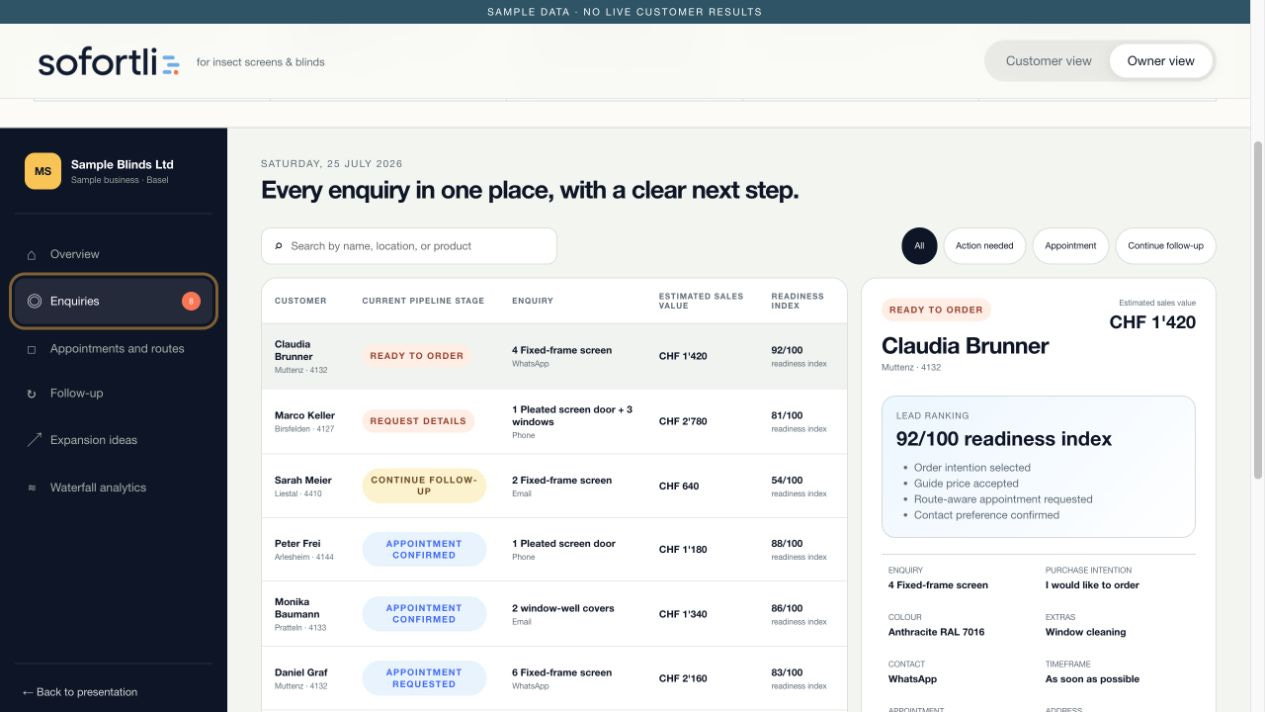
Sofortli working demonstration. All people, values and scores are sample data. The public interface currently says readiness index; priority index is the intended operating term.
One sample enquiry receives 92/100 because the customer selected an order intention, accepted the guide price, requested a route-aware appointment and confirmed a contact preference. Those factors remain visible beside the score. This is a transparent summary of current signals. A genuine conversion probability would require historical outcomes, validation and continued calibration.
The system also proposes a route for requested appointments. This matters because a pleasant booking screen can still create a poor operating day if visits are accepted one by one without considering geography.
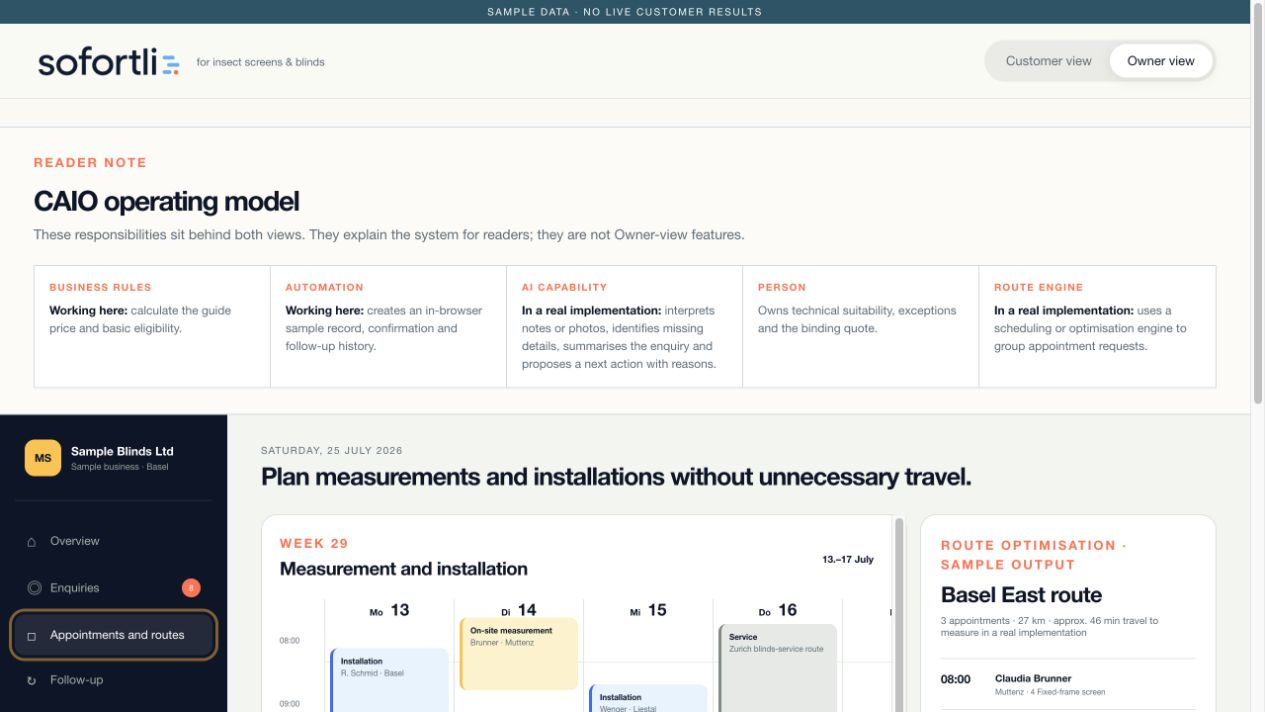
Sofortli working demonstration. The screen shows a sample route of 3 appointments, 27 kilometres and approximately 46 minutes of travel. Live savings remain untested.
And I would want the lead-to-sale waterfall, because individual records tell me what to do next while the funnel tells me where the whole process is thinning out. In the sample data, 25 enquiries receive a guide price, 17 accept it and 12 book an appointment. The largest single-stage loss is the 8 enquiries between guide-price creation and acceptance. That gives the owner one stage to inspect, perhaps the wording around the range, and one change to test the following week.
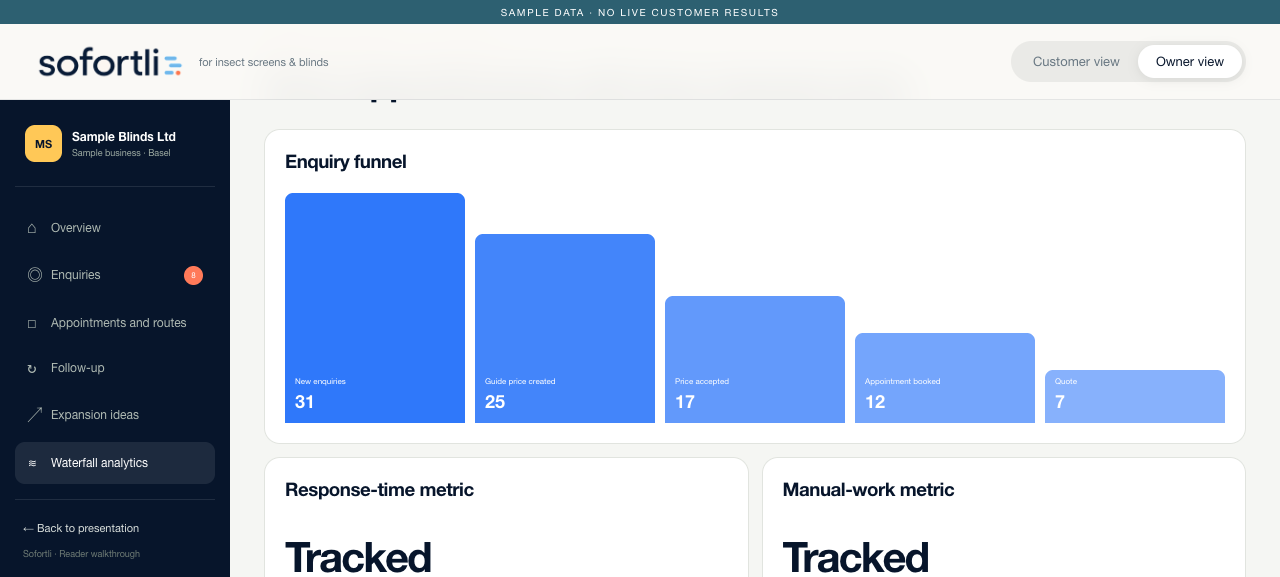
Sofortli working demonstration. The funnel and recommendation use sample data. Stage losses and commercial impact require evidence from a live business.
These 4 decisions connect the visible feature to the commercial question I would ask after 30 days.
Does the customer continue? The system shows a guide range before contact details and records the customer’s intention. I would test journey completion, visits that produce quotes, signed quotes and travel per signed order.
Where does the owner focus today? One CRM record holds estimated value, stage, next action and an explainable priority queue. I would test response time for high-priority leads, overdue actions and signed value per available owner hour.
Which visits fit the working day? Route-aware appointment choices create a proposed daily sequence. I would test travel time, fuel use, productive visits per day and travel per completed job.
Where is value being lost? The lead-to-sale waterfall shows stage counts, open value and the largest loss point. I would test stage conversion, stalled pipeline value and the result of each weekly intervention.
Name the mechanism correctly
Once I knew what the customer needed, what I needed as the owner, which outputs mattered and which rules controlled the offer, the technology choices became much clearer.
This is the part I think commercial leaders need to become strict about. A workflow can contain AI without every useful thing inside it becoming an AI feature. When the whole system receives one label, the investment case becomes vague, accountability disappears, technical teams receive a poor brief and the business cannot tell which part produced the result.
The Sofortli workflow contains information design, a CRM data model, business rules, automation, optimisation, analytics, AI and qualified human judgment. The 12 jobs were:
Help the customer identify the need and next step: information design.
Store the enquiry, value, stage and next action: CRM data model.
Calculate the guide range and check normal conditions: approved business rules.
Create the record, confirm the enquiry and trigger follow-up: automation.
Rank early enquiries from visible signals: transparent business rules.
Group requested visits against addresses, time windows and capacity: scheduling or optimisation.
Count movement through the commercial stages: analytics.
Interpret free text, voice, language variation or photographs: AI with confirmation.
Identify missing decision-critical information: AI with confirmation.
Prepare the customer response from controlled inputs: AI with confirmation.
Prepare the owner’s decision briefing: AI with confirmation.
Confirm suitability, measurements, exceptions, final price and complaints: qualified person.
The guide price is a rule calculation. The confirmation email is automation. The route is an optimisation problem. The funnel is analytics. The CRM is the operating record. Calling all of them AI makes the architecture sound more advanced and leaves the commercial leader with less control.
Lead ranking deserves special care. Sofortli currently uses visible factors to create an explainable readiness score, which I would rename a priority index. A future conversion model would be a different capability. It would require enough historical enquiries with known outcomes, a validated relationship between the signals and actual sales, calibration, monitoring and a clear policy for how the prediction may be used. Until that evidence exists, the transparent rule-based queue is the more governable mechanism.
The 4 jobs I would give AI
AI appears as one mechanism in the architecture, and it performs 4 different jobs inside that boundary. Each output is a proposal for confirmation, with the customer source and the reason kept visible.
1. Interpret the enquiry
A customer may write “I need something for the balcony door,” speak another language, attach a voice message or send photographs without knowing the product name. AI can interpret that material and propose a structured record: likely need, product route, location, dimensions supplied, missing details and stated intention.
The customer confirms the interpretation when possible. The owner sees the original source beside the proposed structure. I would measure how often the proposal is accepted, corrected or rejected, and whether it reduces manual data entry and repeated clarification.
2. Find the missing decision-critical information
The next question depends on what the customer already supplied. A fixed form can require every possible field, which makes the journey longer. AI can compare the enquiry with the information required for the next business decision and propose one relevant clarification.
For example, it may identify that the photograph is useful but the opening direction is missing, or that dimensions are present but the address sits outside the normal route. Business rules still define which information is mandatory. AI interprets the gap and prepares the question.
I would measure enquiry completeness, the number of clarification rounds and how often the AI asks for information that the owner considers unnecessary.
3. Prepare the customer response
AI can draft a full response using the customer’s own choices and the current CRM stage. The approved price table supplies the range. Approved delivery terms supply the conditions. The route engine supplies the available appointment choices. AI turns those controlled outputs into a relevant message in the customer’s language.
The same role can support proposal follow-up, a quality check 1 month after installation, and useful contact after 6 months and 1 year. For this type of business, later contact could cover seasonal cleaning or a relevant add-on. Automation owns the timing. AI prepares the message within the approved commercial boundaries.
I would measure preparation time, response time, owner edits, customer replies and proposal-to-sale conversion. A fast message that needs a complete rewrite has created extra work, so speed has to be read together with acceptance and correction.
4. Prepare the owner’s decision
AI can assemble the enquiry into a short briefing: what the customer wants, which information is complete, which issue needs attention, what the current value and stage are, and which next action appears appropriate. It can explain which source signals support the recommendation.
The owner confirms, changes or rejects that action. Those corrections become evidence about where the recommendation is useful and where the system needs a tighter rule, better context or a different escalation path.
I would measure preparation time, recommendation acceptance, owner override patterns, overdue high-priority actions and signed value per available owner hour.
The physical measurement remains with a qualified person. As the owner, I carry the cost when a measurement is wrong and the work has to be repeated. I would also keep complaints with myself or my team, because that is where responsibility and judgment matter most.
This is why AI was the fifth design decision. It entered after the commercial problem, the 2 user views, the required outputs and the operating rules were clear. I assigned 4 specific jobs to AI where variable language, context and volume created work that the team could not handle consistently. Every other job kept the mechanism that made it easiest to explain, test and govern.
The 30-day test
The current public demonstration implements the guided customer journey, sample price rules, in-browser records and automation history. It shows sample route planning, a ranked owner queue and the lead-to-sale funnel. AI interpretation and recommendation are design intent for a real implementation. Every person, price and result in the demonstration is sample data.
After 30 days in a real business, I would want one screen to tell me:
how many leads arrived outside normal office hours or while the team was busy;
how quickly each lead received a useful first response and then an offer;
how lead-to-sale and proposal-to-signed-order conversion changed;
how fuel, vehicle use and travel time compared with the sales produced by the route;
how many new customers entered through a journey that the old process would have missed;
how much open pipeline value had an on-time next action.
I would read those numbers together. If many customers receive a proposal and disappear, that stage needs work. If high-priority leads wait too long, the team is following the wrong order. If the route looks efficient and sales remain unchanged, the driving plan is solving a smaller problem than the commercial one.
That is the test I care about. The system should help the owner see the difference between activity and result, then put limited time where it has the best chance of producing a sale.
The CAIO job
The CAIO job, as I understand it, is to carry responsibility for the chain between a business problem and an accepted operating result. That chain includes the customer experience, the owner’s decision, the mechanism, the evidence and the person who remains accountable.
Sofortli is deliberately small, so the chain fits across 2 screens. Inside a larger company, the same customer signal may cross several systems and ownership boundaries before anyone acts. The distance makes the design discipline more important.
Take one AI use case currently sitting in your roadmap and draw the 2 views. In the user view, write down what the person is trying to achieve, what they know and what would give them enough confidence to continue. In the owner view, write down the decision the business must make, the information required, the explicit rules, the repeated actions, the point where variable input needs interpretation and the person who owns the consequence.
Then attach one business measure to the complete loop. When you can name the input, output, decision owner and baseline in one breath, you have something you can govern.
Open the Sofortli working demonstration and follow one sample enquiry through the customer and owner views. Every person, price and result shown there is sample data.
Subscribe and get the ready Claude skill for identifying your first AI use cases. The Closed Gap is where I share practical AI system designs with the mechanism, owner and evidence made explicit.